History of Political Violence
“Violence can destroy power; it is utterly incapable of creating it.”
— Hannah Arendt, On Violence (1970)
This shows exactly the reason why political violence is illogical. In the simplest terms possible, this quote is stating that violence can end power, but can never make it reform into the way perpetrators were seeking. In fact, it ends up to be worse for assailants in this case. For example, Robespierre ended up beheaded, after executing thousands during the Reign of Terror. Additionally, and aside from argumentation, what does it mean morally? For what is the value of life in their minds, to mere political beliefs? They are to two different degrees; what may come with life, and life itself. With all of this, I do believe political violence is wrong. While it may seem obvious to many, especially since many people worldwide have expressed desire for peace for so long, it only takes one to act violently. Only if all will agree, it will be a solved problem. Sadly, this makes it a problem that will not be fixed, but that does not mean it cannot be avoided. With that being said, let me take a dive into the history of political violence.
Circa 44 BC (BCE), Julius Caesar is assassinated. Though political violence had occurred long before, this was a major turning point in history. Rome had been a Republic for centuries, a widely respected form of government, promoting fairness and giving a say to all. Caesar rose in popularity as a politician and general, especially after conquering Gaul, an area that covers present-day France, Belgium, and parts of Switzerland, Germany, and Northern Italy. In 49 BC (BCE), Julius Caesar’s army crossed the Rubicon River, which was a deliberate violation of Roman law, which forbade generals from bringing their armies into Italy. This act directly precipitated a civil war in Rome. This was obviously foreseeable though, as there were many conflicts between Caesar and Pompey the Great, who commanded armies and administered new territories in the east, and was once Caesar’s ally, but later his rival. Through the next three years, Pompey flees to Egypt, where he gets assassinated, and Caesar gets tangled in Egyptian politics. Ultimately, once Caesar returns to Rome, he is appointed as somewhat of a dictator for ten years. He then launched reforms, including reorganizing the calendar (Julian Calendar). Many senators saw Caesar as corrupting the Republic, which led to him being stabbed to death by about 60 of them.
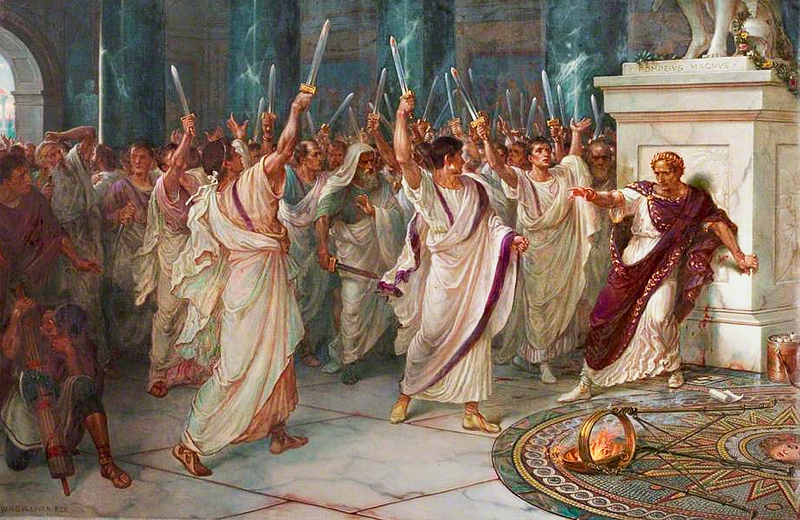
The assassination of Julius Caesar, and the events leading up to it, displays our main idea perfectly. Yes, Caesar was corrupting the Republic, but let’s take a look at the aftermath. Instead of restoring the Republic, the assassination led to chaos, anarchy even, and civil wars. In the end, the murder of Julius Caesar led to Rome’s Republic meeting its perpetual demise, which happens to be the opposite effect of what the senators wanted. History has repeated itself with this situation many times. Even in the case of Abraham Lincoln’s assassination, Andrew Johnson, Abe’s successor, was a horrible president, and sent the country into a spiral. He reversed much of Abe’s progress and reconstruction. But in the end, Ulysses S. Grant established the 15th Amendment, prohibiting states to deny citizens their right to vote based on their race.
When all is said and done, political violence is never a solution. Even with pure hatred towards someone, it is extremely illogical. No problems will be fixed, in fact, many more will be created. In this day and age it has become something that is taken too lightly. Plus, we all recognize how bad it is, yet we don’t do nearly enough to prevent it. I do hope that it will be fixed, because it makes our country dangerous, and scarier to live in. Thank you for reading Social Science 43, and have an amazing day.
Comments Section
Share your thoughts here!